
Background
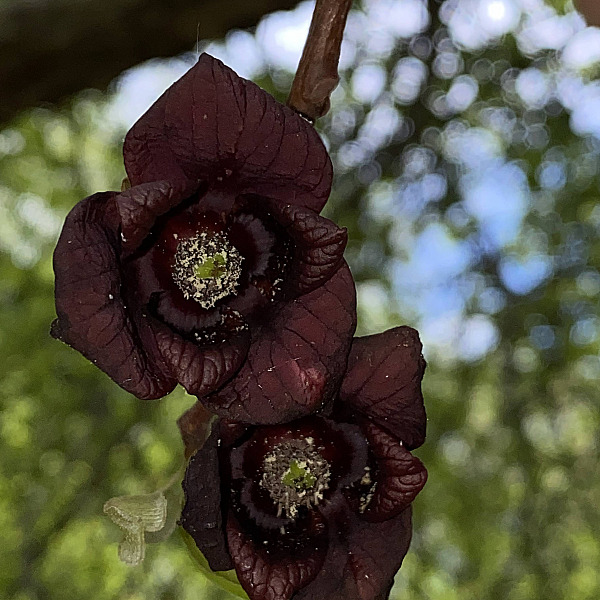
Pawpaw (Asimina triloba) is a small deciduous tree in eastern North America, notable for having the largest native edible fruit on the continent (Callaway, 1990; Moore, 2015). Growing in climates with warm-to-hot summers and cool-to-cold winters, it is typically found in clonal thickets along water bodies and prefers mildly-acidic deep soils. It is part of a tropical family of Annonaceae (“custard apples”) yet has migrated north to Michigan, Ontario (Canada), and New York (NY). It is listed as a threatened or endangered species in northern states and provinces, and in NY it is known to grow in only ≈20 locations (Young, 2019). Given its edibility and native status, it has recently garnered interest as an edible plant from horticulturalists and native food growers. Climate change will likely increase the suitability for growing pawpaw at its northern range limit (Wyatt et al., 2021a).
Researchers have debated how pawpaw dispersed northward after the last glacial maximum. Some researchers have argued that its dispersal was due to fruit consumption by animals (i.e. zoochory), including now-extinct prehistoric megafauna (Murphy, 2001). However, others have suggested that given the palatability of pawpaw, Native Americans facilitated its northern migration via trade or acquisition via wartime raiding (Keener & Kuhns, 1997). Others have suggested that its migration could have been facilitated by both natural and anthropogenic mechanisms (Wykoff, 2009). A recent genetic analysis suggested that given (1) the low genetic diversity of pawpaw populations at its northern limits and (2) the presence of rare alleles shared between northern populations and populations hundreds of kilometers away, that prehistoric human-facilitated dispersal is responsible for the northerly distribution of pawpaw (Wyatt et al., 2021b). This contention is supported by the discovery of pawpaw remains at archaeological sites in NY (e.g. Gerard-Little, 2017), as well as ethnographic accounts of the 17th century.
While the findings of Wyatt et al. (2021b) are noteworthy, their analysis was limited in four ways. First, their study only analyzed two pawpaw populations in NY and no populations in Ontario. Second, it is possible that pawpaw dispersed across southern Ontario naturally into NY, a scenario that this paper could not address since it did not collect samples in that province. Third, it did not rigorously compare the locations of pawpaw in NY to nearby archaeological sites to reveal a more fine-scale understanding of whether Native American land use may have been cultivating pawpaw in present-day NY. Finally, the genetic methods used were limited: microsatellite markers give much lower resolution than markers derived from next-generation sequencing methods such as genotyping-by-sequencing (GBS), which surpass microsatellites when assessing individual genotype information and determining relatedness of populations.
Purpose
Dr. Stephen J. Tulowiecki at SUNY Geneseo has published previously on the geographic distribution of pawpaw (Tulowiecki, 2021). We are working in partnership with him, to advance research into the geographic origins of pawpaw toward its northern range limits. We will focus on NY given Dr. Tulowiecki’s expertise of this geographic area, but we will also strive to study pawpaw populations in southern Ontario and northwestern Pennsylvania, in order to address the limitations of previous research described above. We are obtaining samples of pawpaw leaves in NY, Ontario, and northwest Pennsylvania from field visitation and herbarium samples and comparing locations of pawpaw to nearby archaeological sites to infer which pawpaw populations are natural and which are purportedly anthropogenic in origin.
This internship project will focus specifically on the genetic analysis of the pawpaw samples described. DNA has been extracted from fresh and silica-dried leaf samples using the DNAeasy Plant Mini Kit (Qiagen). GBS libraries will be made for a subset of samples and sequenced using Illumina NovoSeq to ensure the arrival of data prior to the start of the internship. We have previously used this approach to successfully assess diversity across the geographic range of pawpaw (but excluding NY and Ontario) and the Pawpaw Variety Trial (Pomper et al., 2003). Sequencing reads will be mapped to the pawpaw genome that we have built in-house and variant sites will be called using the Genome Analysis Toolkit (McKenna et al., 2010). These data will be evaluated in conjunction with previously generated data from samples across the species’ range. Genetic diversity will be calculated, population stratification will be evaluated with STRUCTURE (Pritchard et al., 2000), and we will assess migration using the fixation index (FST). We will also use a phylogenomic approach to assess relatedness between populations. The results of these analyses will help determine the evolutionary history of NY pawpaws.
Bibliography
Callaway, M. B. (1990). The Pawpaw. Kentucky State University.
Gerard-Little, P. (2017). “A Pleasure Garden in the Desert, to Which I Know No Comparison in This Country”: Seneca Iroquois Landscape Stewardship in the 17th and 18th Centuries [Ph.D. dissertation]. Cornell University.
Keener, C., & Kuhns, E. (1997). The impact of Iroquoian populations on the northern distribution of pawpaws in the Northeast. North American Archaeologist, 18(4), Article 4.
McKenna, A., Hanna, M., Banks, E., Sivachenko, A., Cibulskis, K., Kernytsky, A., Garimella, K., Altshuler, D., Gabriel, S., Daly, M., & DePristo, M. A. (2010). The Genome Analysis Toolkit: A MapReduce framework for analyzing next-generation DNA sequencing data. Genome Research, 20, 1297–1303.
Moore, A. (2015). Pawpaw: In Search of America’s Forgotten Fruit. Chelsea Green Publishing.
Murphy, J. L. (2001). Pawpaws, persimmons, and ’possums: On the natural distribution of pawpaws in the Northeast. North American Archaeologist, 22(2), Article 2.
Pomper, K. W., Layne, D. R., Peterson, R. N., & Wolfe, D. (2003). The Pawpaw Regional Variety Trial: Background and early data. HortTechnology, 13(3), 412–417.
Pritchard, J. K., Stephens, M., & Donnelly, P. (2000). Inference of population structure using multilocus genotype data. Genetics, 155, 945–959.
Tulowiecki, S. J. (2021). Modeling the geographic distribution of pawpaw (Asimina triloba [L.] Dunal) in a portion of its northern range limits, western New York State, USA. Plant Ecology, 222, 193–208.
Wyatt, G. E., Hamrick, J. L., & Trapnell, D. W. (2021a). Ecological niche modelling and phylogeography reveal range shifts of pawpaw, a North American understorey tree. Journal of Biogeography, 48(4), 974–989.
Wyatt, G. E., Hamrick, J. L., & Trapnell, D. W. (2021b). The role of anthropogenic dispersal in shaping the distribution and genetic composition of a widespread North American tree species. Ecology and Evolution, 11, 11515–11532.
Wykoff, W. (2009). On the natural distribution of pawpaw in the Northeast. The Nutshell, 23–32.
Young, S. M. (2019). New York Rare Plant Status Lists. New York Natural Heritage Program, New York State Department of Environmental Conservation. https://www.dec.ny.gov/docs/wildlife_pdf/2019rareplantlists.pdf

